A New Path for Homeless Families
By Suzy Frisch | Photography by Paul Middlestaedt
Thanks to community support, New Pathways, a Cambridge-based nonprofit serving unhoused families in Central Minnesota, has opened a new 12,000-square-foot facility this summer.
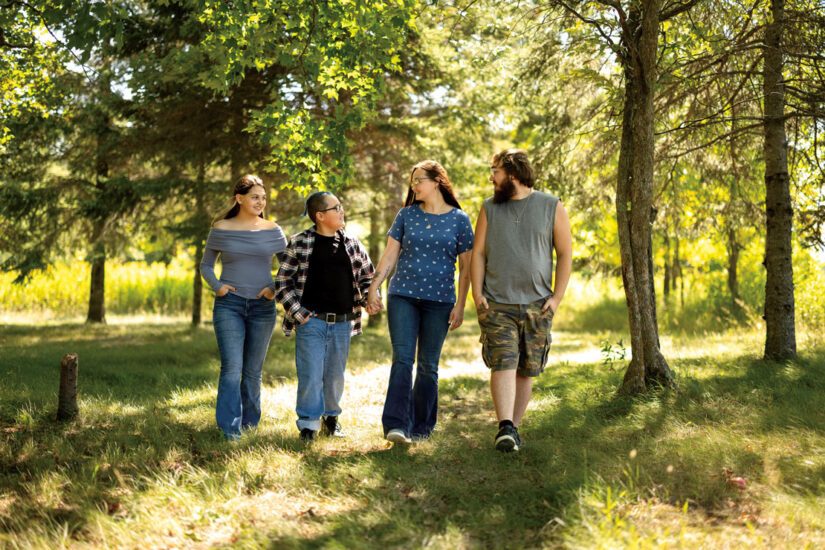
In her 20s, Kristy Talley found herself trapped in a cycle of domestic violence, drug use and homelessness. Living with her three young children, she knew her situation was dangerous, but leaving felt impossible.
Talley’s mother and sister repeatedly tried to connect her with help. She wasn’t ready, until one day she was.
When Talley walked into New Pathways, Inc., in 2019, she took the first step toward rebuilding her life. In just over a month, staff helped her and her children secure a subsidized apartment, find employment and begin building a more stable future.
“At first, it was really scary and almost unbelievable that these complete strangers could love and care about me,” Talley said. “They were concerned, non-judgmental, and their arms were so open and welcoming. They are eager to make sure you have everything you need and all the services that help you with the problems you’re having.”
Now, New Pathways hopes to help many more families find that same stability.
Thanks to $3.75 million in community support, the nonprofit has opened a new 12,000-square-foot facility in Cambridge that more than doubles its capacity. The permanent, round-the-clock shelter can house up to 10 families, or as many as 33 individuals, including large and multigenerational families.
The expansion comes as homelessness continues to affect families across rural Minnesota, even though the issue is often associated with larger cities. According to the Institute for Community Alliances, about 3,500 of Minnesota’s 10,500 unhoused residents live in rural areas. In Central Minnesota, 828 people were experiencing homelessness in 2025 and 881 in 2024.
Since 2000, New Pathways has served families in Chisago, Isanti, Kanabec, Mille Lacs and Pine counties. For years, demand has outpaced available space.
“Throughout the years, we have turned away at minimum just as many people as we’ve been able to serve,” said Mary Westlund, New Pathways executive director. The hardest part of her job, she said, is not being able to help everyone who needs it.
The organization’s approach differs from many traditional shelters. Families can stay for up to six months while receiving intensive support services designed to help them achieve long-term stability. Residents receive counseling, family education, assistance finding housing and opportunities to build community connections.
COVID Accelerates Plans
The need for a larger facility became especially clear during the COVID-19 pandemic. At the time, families spent their days receiving services at New Pathways, then moved to local churches each evening for meals and overnight accommodations. Pandemic safety restrictions disrupted that model.
New Pathways secured funding for hotel rooms, but the arrangement was expensive and difficult to sustain.
That experience accelerated long-standing plans for a permanent facility where families could remain in one location while receiving services. This summer, that vision became reality.
Families now live in upper-level private apartment-style units with full bathrooms rather than moving between multiple sites. The building’s main floor also includes indoor and outdoor play areas, a living room, food pantry and donation center for furniture and household goods.
The project gained momentum in 2022 through the Initiative Foundation’s Transformative Funding for Nonprofits program, conducted in partnership with the Otto Bremer Trust. A $60,000 grant helped New Pathways identify a location, begin building design work and launch a capital campaign. The project was bolstered by a subsequent Initiative Foundation-Otto Bremer Trust Community Responsive Fund grant for $45,000 in 2024. The city of Cambridge also sold land near downtown to the organization for $1.
One of the campaign’s major milestones came when the Memorial Hospital Foundation, a Partner Fund of the Initiative Foundation, contributed $500,000 to the project.
The Memorial Hospital Foundation’s mission focuses on supporting health-related initiatives in Isanti County. Board members saw a direct connection between housing stability and health outcomes, said Lowell Becker, chair of the Memorial Hospital Foundation.
“Unfortunately, a lot of the people who are there have health issues,” said Becker, a retired medical doctor. “That might range from a history of chemical dependency, or having autistic or disabled children, or mental health issues.” Time at New Pathways can feel like a break and a chance to change the rest of their lives, he said. “Having the opportunity to help people get in a better situation and have some stability was a no-brainer.”
The Memorial Hospital Foundation later donated an additional $120,000 to create an outdoor gathering space.
A Community-Led Gift
For Westlund, the campaign demonstrated how deeply the community understood the need.
“I think our community knows there is a need and they wanted to be part of the solution,” she said. “This is such a gift we were given by our community.”
The larger facility also allows New Pathways to expand services. The organization now hosts additional outside providers, including two clinical social workers licensed as drug and alcohol counselors and a wellness coach.
Westlund said those resources strengthen a model that already produces strong outcomes. Regional homelessness data compiled through the Central Minnesota Continuum of Care (See Tracking the Region’s Trends) show that transitions into permanent housing remain a significant challenge across the broader system. New Pathways reports that 60 to 80% of the families it serves move into permanent housing, a result the organization attributes to longer stays, intensive case management and wraparound support services.
“It’s not just about housing,” Westlund said. “There are so many factors that contribute to stability, and we’re trying to address all of them. This is a place for healing and hope and putting the pieces back together and helping families get back on their feet.”
Talley experienced that approach firsthand.
Staff helped her address barriers to long-term stability, including removing an eviction from her record, securing medical and food benefits, and connecting her with a supportive network. She moved into a permanent apartment, found new employment and maintained the sobriety she began the day she entered New Pathways.
“It was a game changer,” Talley said of her time at New Pathways. “All of the love and support blew my mind. These people care. You can see it and feel it. I’ve been completely blessed.”
Seven years after New Pathways opened its doors to Talley, the organization has opened much larger ones for families who follow her.
The new facility cannot eliminate family homelessness in east-central Minnesota. But it gives more parents and children access to the same combination of safety, stability and support that helped Talley rebuild her life. It also offers New Pathways the opportunity to serve many more families in the years ahead.
TRACKING THE REGION’S TRENDS
The Central Minnesota Housing Partnership helps coordinate the region’s Continuum of Care and works with local partners to collect and analyze homelessness data. Much of that information comes from Minnesota’s Homeless Management Information System, which the Institute for Community Alliances administers statewide. The data helps communities understand the scope of homelessness, track outcomes and guide housing and service investments.
Learn more at cmhp.net/continuum-care