Enterprising Solutions
A new program helps immigrants and refugees overcome small business barriers.
By Lisa Meyers McClintick | Photography by John Linn & Lisa Meyers McClintick
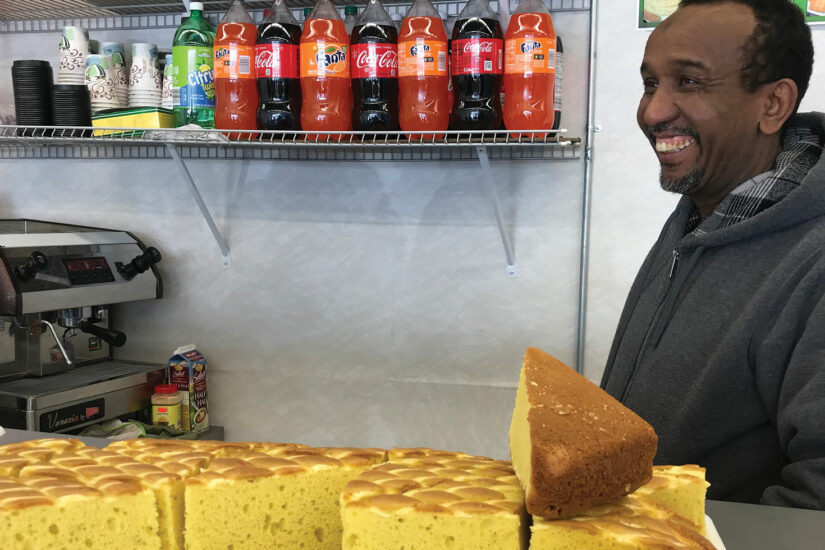
While sipping a steaming cup of shaah, a Somali version of sweet, spiced tea, Jama Alimad, is happy to share the diverse culture of his coastal home country where Middle Eastern, European and Asian cultures thread into what has long been a northeastern gateway to the African continent.
“This is anjera,” he said, showing how people from Somalia use torn pieces of pancake-like bread to scoop up seasoned blends of beef or chicken that are served at Salaama, a restaurant in a strip mall at St. Cloud’s intersection of 33rd Street and Third Avenue Northwest.
At a time when Somali restaurants, food markets and malls with kiosks are popping up across St. Cloud, Alimad is using his position as a community leader and elder to encourage his fellow Somalis to find the resources they need to start their own businesses. One such resource is the new Enterprise Academy program, which the Initiative Foundation has launched to help new entrepreneurs get past small-business barriers so they can succeed and thrive. In turn, these new businesses can enrich and add stability to the community and strengthen the area’s economy.
“This is a very entrepreneurial group of folks,” Jeff Wig, the Initiative Foundation’s vice president for economic and business development, said of the East African population with whom he and partner organization Central Minnesota Community Empowerment are piloting the program. “They have the fire and commitment to start a small business.”
They also have a passion for sharing their culture. Restaurateurs especially can offer a bridge between Somalis and the lifelong St. Cloud residents who are eager to be among the city’s first to try their food, sip their tea and get a glimpse into Somali heritage.
MULTICULTURAL MALL
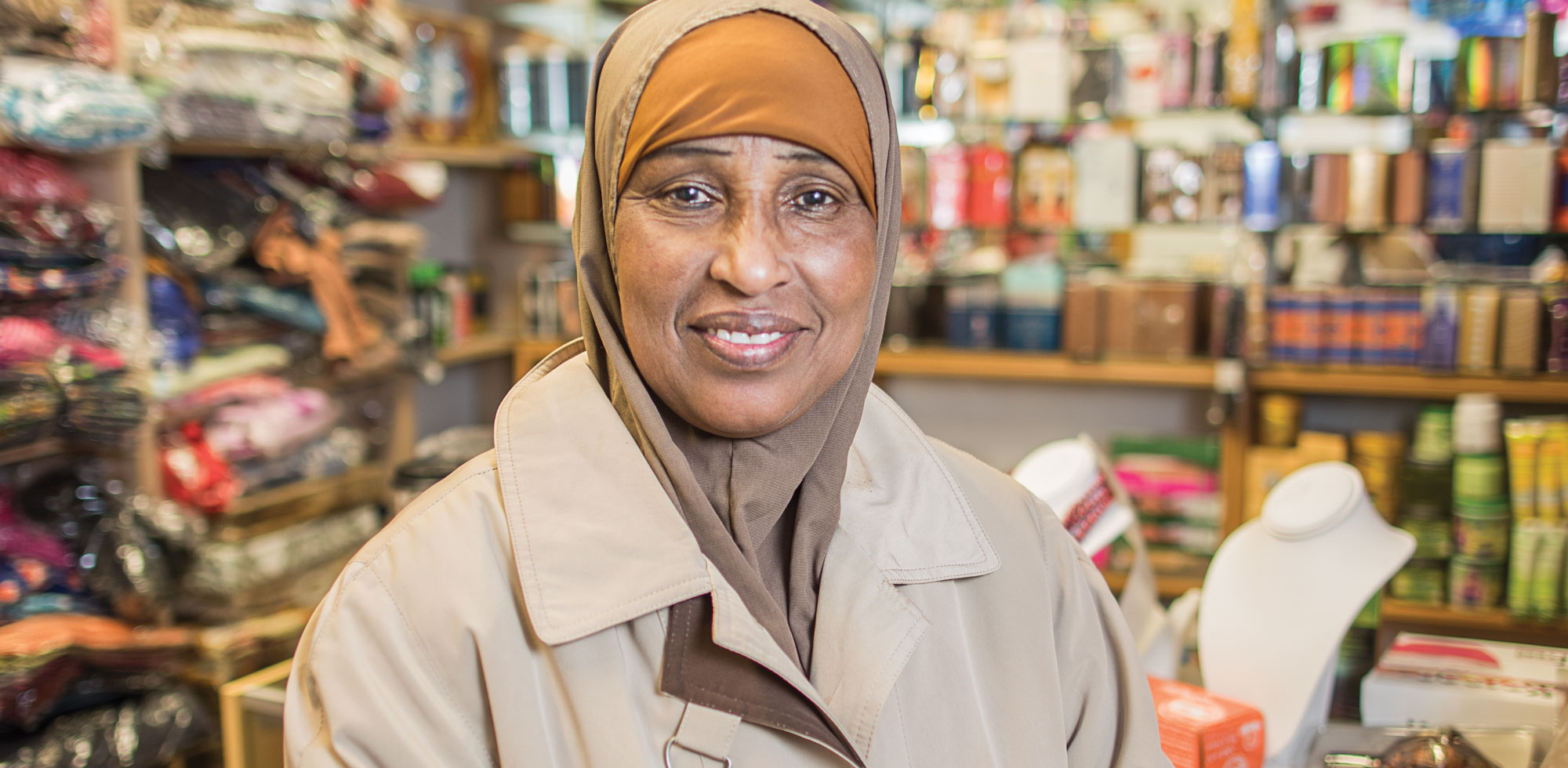
In Banadir Mall in Waite Park’s Gateway Center, a handful of women smile and greet visitors from a few of the 17 rentable business spaces. The small shops give these women an affordable option for launching a business. Women, in particular, drive the community’s entrepreneurial spirit, Alimad said.
Sahra Shukri, who is fresh off a night shift at Gold’n Plump’s chicken processing plant in Cold Spring, opens her Somali Senteral Store in the morning. It stretches her workday into 18 hours, after which she checks in with her family and hopes for a few hours of sleep before she starts another night shift at the plant.
The strong work ethic is a source of pride for many in the Somali community. “People think Somalis are getting things for free, and they don’t see how hard many of them work,” Alimad said.
At Banadir Mall, most of the small business owners have off-site, full-time work shifts, which often finish up around 3 p.m. As a result, the mall bustles from mid-afternoon through the evening. Many of the businesses sell selections of imported products: lotions, perfumes, scarves, blankets, rugs, silk flowers and tea sets.
Twahiv Afrah, who operates the Farbuur Store, struggles to communicate in English but radiates motherly pride when talking about her three children, including a daughter, Amina, who received her degree from St. Cloud State University. Amina works as a nurse with CentraCare and has been featured on some of the clinic and hospital posters.
NEW OPPORTUNITIES
The Initiative Foundation worked with Somali elders and other community leaders to get the word out about the 12-weeks Enterprise Academy training that started at the end of March. It expands on a five-week training project in 2016 that helped several dozen Somali residents create business plans for their own entrepreneurial ventures.
To expand its effort, the Initiative Foundation received a $200,000 grant and a $600,000 loan from Wells Fargo through its Works for Small Business: Diverse Community Capital program. Additional support comes from the Kansas City-based Kauffman Foundation.
The Initiative Foundation is adapting a successful model created by the Twin Cities-based Neighborhood Development Center (NDC), which offers offers training, startup loans and business incubator space to small businesses as a way to inspire entrepreneurship and fill vacant buildings. As businesses gain customers and financial traction, they can expand and move out, leaving space for other new businesses.
One of the NDC’s most successful and visible efforts was the launch of Mercado Central, a Minneapolis center of more than 35 small Latino businesses that opened on Lake Street in 1997. The group also is responsible for Midtown Global Market, a popular Minneapolis food hub that opened in 2006 and serves anything from Moroccan tagine cooking to Middle Eastern kabobs to Latin American tamales to Thai noodles. Midtown Global Market comprises more than 50 businesses and represents 22 cultures. It goes beyond food and functions as a gathering place for events, serving an estimated 1.5 million patrons a year.
In addition to St. Cloud, other cities across the nation have taken notice and found inspiration from Midtown Global Market and Mercado Central. The NDC model is being adopted in Detroit, Syracuse, Philadelphia and Anchorage, among other places.
TRAINING AND COACHING
While it’s being piloted with St. Cloud’s East African community, the ultimate goal with the Enterprise Academy is to adapt it to different areas of need in the 14-county region of Central Minnesota. The fundamentals of the program leverage the NDC model to include one-on-one coaching and business planning; micro-lending and financing strategies; and assistance with everything from developing logos and store layouts to navigating bookkeeping programs to accepting credit card payments.
For the NDC, the goal is to build entrepreneurs to build neighborhoods. “And hopefully these entrepreneurs become neighborhood and civic leaders,” said Isabel Chanslor, the NDC’s chief program officer.
FUTURE LEADERS
The natural clustering of Somali businesses makes it easier for business owners to share what they’ve learned and to build on each other’s successes.
Salaama’s owner, Liban Ahmed, has a brother who runs the nearby Star Market grocery. A few doors down, Afya Pharmacy caters to the Somali population; the staff makes free home deliveries and ensures elderly patients know how to take their medicine. This keeps health care costs down because people are healthier and less likely to need a hospital visit.
At stores such as the Green Market & Deli in Waite Park’s Gateway Center on 10th Avenue South, there’s a dining area that includes a glass case full of savory and sweet pastries. Adjacent is an attached grocery store with aisles that mix familiar items such as Cheerios, ketchup and spices with tins of fish, bags of sorghum flour and exotic fruit juices.
Wig said non-Somali customers account for about 1 percent of the business at St. Cloud’s estimated 10 restaurants that serve traditional East African foods. But that may change as they develop easy-to-understand menus and the general population gets accustomed to new foods, such as goat and saffron rice, sambusas, and a version of spaghetti, which Italians brought to Somalia when they colonized part of the country in the 1890s.
Enterprise Academy aims at helping these businesses succeed, and that excites local leaders such as Abdirizak Jama, community organizer at Catholic Charities, a soon-to-be graduate from Saint John’s University and an executive member of the Central Minnesota Community Empowerment Organization.
“The amount of opportunity that this will bring to the community of St. Cloud is just mind-blowing,” said Jama.
By the Numbers
The first Enterprise Academy cohort will get its start in St. Cloud with a focus on the East African population. As the program is refined and funding is secured, the plan is to offer it in other areas of Central Minnesota where its wrap-around training and services can lift up entrepreneurs and encourage business startups.
St. Cloud Snapshot
10,000 The estimated number of East Africans living in the Greater St. Cloud area.
50 The number of East African-run businesses operating out of several commerce hubs in Greater St. Cloud.
3 The percentage of businesses owned by people of color in Greater St. Cloud. The Census Bureau’s 2012 survey of business owners shows that people of color represent 8.2 percent of the region’s population.
According to Minnesota Compass, the median household income for people who identify as African-American/black, and who also indicate they are foreign-born, is $28,884. The statewide average for all populations is $57,571. Source: U.S. Census Bureau’s 2010-2012 American Community Survey.