A Place to Call Home
At Washington Place, Minnesota veterans get help with daily living. They also get a much-needed dose of friendship.
By John Reinan | Photography by John Linn
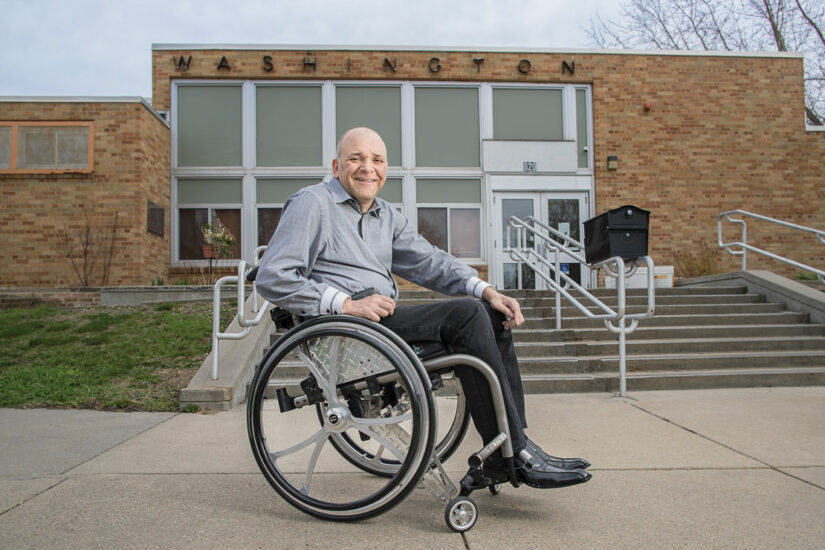
When a St. Cloud assisted-living facility that provides a home for more than 40 veterans came on the market in mid-2016, Jay Johnson saw a unique opportunity to help more Minnesota veterans get the support they deserve. As a disabled veteran himself—Johnson was discharged from the Navy in 1990 after he became a paraplegic in a car accident—he was well aware of the challenges that former military men and women face. By some estimates, as many as 6,000 vets in the state qualify for housing assistance but aren’t taking advantage of it.
Johnson is CEO of HealthNorth, a St. Cloud-based home health care provider that supplies personal care services as well as equipment such as wheelchairs, scooters, hospital beds, ostomy supplies and other medical needs. The company employs about 150 people and is looking to expand.
Washington Place, which is located in a repurposed elementary school, was an opportunity that fit with Johnson’s views about what’s needed in the market. “It’s one of the reasons I set up my company,” he said. “I use a wheelchair, so I understand people who have disabilities. And so I always thought I could do better than the next company that’s out there providing services.”
In fact, Johnson designed and engineered his own wheelchair, a creation that can lift the user from a sitting to a standing position. A graduate of St. Cloud State University, he received the university’s Graduate of the Last Decade (GOLD) Award in 1999. Washington Place presents another opportunity for Johnson to use his personal insights to improve what’s available for today’s veterans.
The synergy works well for HealthNorth customers, and Johnson hopes to add more assisted-living facilities to his portfolio. “It’s a nice coupling of businesses,” he said. “Assisted living was always a target for HealthNorth to have under our umbrella of companies.”
Most of the vets at Washington Place suffer from mental health issues, drug and alcohol problems or post-traumatic stress disorder. They range in age from 38 to 76. The majority are Vietnam-era vets, but there’s a younger contingent that served in Iraq and Afghanistan. With a place to live, and a supportive environment, many of them are able to operate successfully in the larger community. Some hold down steady jobs.
“If not for this, many of these veterans would be on the streets,” said Jim Nierenhausen, the facility’s chief operating officer.
A Demand For Jobs
Healthcare jobs are the largest sector of Minnesota’s economy and are showing strong growth, both statewide and in the St. Cloud region. In the Initiative Foundation’s Central Minnesota service area, healthcare provides more than one in six jobs.
That was a key to the Foundation’s support of Washington Place, which provided $30,000 in gap financing. “Healthcare positions tend to be full-time, with benefits, and they pay more than minimum wage,” said Dan Bullert, the Initiative Foundation’s business finance manager. “We always look to get involved with projects that provide good wages and benefits, because along with that comes quality-of-life improvements for the region.”
On average, healthcare jobs in Central Minnesota pay $5,000 to $6,000 more annually than the overall average for all other jobs in the region, according to the state Department of Employment and Economic Development. Healthcare jobs also offer a clear career ladder. Workers who start as certified home care aides or nursing assistants can progress with further education to licensed practical nurses or even registered nurses.
In addition, the multiplier effect of healthcare jobs is higher than in almost any other industry. The growth of healthcare spins off other jobs in food service, hospitality, construction and technology. Washington Place employs about 12 people now, but that could grow as expansion plans are realized.
The facility has a full kitchen and provides three meals a day to its clients. Counselors also take clients to medical appointments and job interviews, monitor medications and refer them to other services as needed, often through the Veterans Administration.

Emotional Care
But there’s an important aspect to the services provided at Washington Place that goes beyond medical charts. “It’s a business, but there’s also a need for that emotional care,” said Nierenhausen. “These vets are human beings who have seen a lot of stuff. Some of them don’t have family, so you become really instrumental in their lives. It’s important to highlight the human part of it. The human touch, talking to people, understanding them, becomes a major factor in their care. The biggest thing I think we provide here is a dose of friendship.”
Washington Place doesn’t have psychologists or social workers on staff, but the caregivers stay in close touch with clients and are ready to offer referrals. “We might say, ‘Mike, maybe you need to go to the VA,’ ” Nierenhausen said. “Or we might suggest they go see a psychologist. It’s all about knowing that person as an individual and helping them get what they need.”
Johnson and Nierenhausen have known each other since their childhoods in Cold Spring, where Johnson’s father was the principal at Rocori High School. Nierenhausen spent years in the granite business, selling monuments.
The Initiative Foundation had a previous partnership with Johnson, providing similar gap financing to help him expand HealthNorth. For the Foundation, it’s especially gratifying to see a business continue to grow after providing a nudge that helped them get over a hurdle.
“At a critical point in the lifecycle of a business, some targeted assistance can make the difference in meeting goals,” said Bullert. “The dollar amount might not be huge, but the impact—the ability to take the business to the next level—can be significant.”
That’s Johnson’s vision. “In business, you kind of know your strengths and weaknesses,” he said. “And this plays to our strengths.”