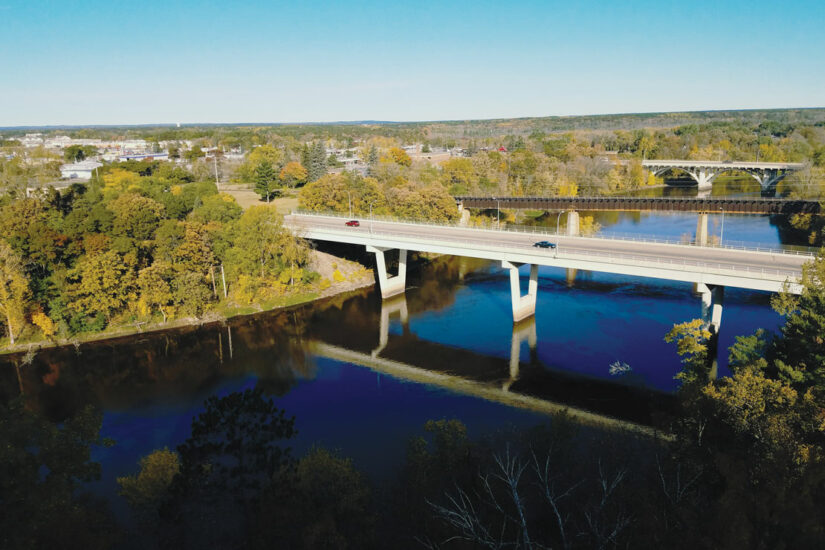
On the Waterfront
Photograph courtesy of Short Elliott Hendrickson, Inc. (SEH®)
Brainerd embraces its prime location on the Mississippi River.
By Elizabeth Foy Larsen
For almost six years, Jennifer Bergman has crossed the Mississippi River on the way to her job as executive director of the Brainerd Housing and Redevelopment Authority
(HRA). The problem, as she sees it, is that instead of being an opportunity to take in the beauty of one of the world’s most famous waterways, her morning ritual is a ho-hum event. “The only reason you know that the Mississippi is there is because there’s a sign that tells you,” she said. “There are very few ways for people in Brainerd to interact with the river.”
That’s likely to change if a group of involved city leaders, businesses and citizens are able to make tracks with the proposed Three Bridges Trail, an over-the-water catwalk that will hug the river’s shoreline and weave underneath the Laurel Street, Washington Street and BNSF Railroad bridges. Community leaders believe the trail will bring nature and recreation lovers to the riverfront and help the river become an economic and cultural focal point.
A History of Water
Brainerd exists because of the Mississippi. The river was first used by Native Americans for fishing and trading, practices that were taken up by explorers when they arrived in the region. When the railways expanded across Central Minnesota, Brainerd was chosen as the site for a railroad bridge because a narrow point in the river made the engineering more cost effective. Industry has also played a role in Brainerd’s riverfront, starting with northern Minnesota’s logging companies. A paper mill began operating in 1898, which eventually became home to both Potlatch Corp. and Wausau Paper.
“For hundreds of years, rivers were the world’s major transportation corridor and wastewater disposal mechanism,” said Don Hickman, the Initiative Foundation’s vice president for community and workforce development. “Being near a river was a good business practice.”
But when the logging industry stopped floating its goods down the Mississippi, Brainerd turned its back on what had once been the city’s center, an action that intensified when trucks, trains and planes overtook river barges as the preferred way to transfer goods. It’s a trend that occurred across the United States.
During the past 50 years, however, river towns like Brainerd have again started to embrace their waterfront locations. The most famous example is the San Antonio River Walk in Texas. A network of walkways on the banks of the San Antonio River, located below street level and car traffic, it’s a dynamic—and much visited—combination of shops, restaurants, museums and historic sights, including the Alamo. Closer to home, Minneapolis has successfully created new residential neighborhoods on the Mississippi, which have given rise to biking and hiking trails and cultural amenities, including the Guthrie Theater, which offers impressive views of St. Anthony Falls.
Brainerd has known for decades that the Mississippi is an underused asset. “The river is fresh and young here,” said Rod Osterloh, a commercial real estate marketer and broker who chairs the Brainerd Riverfront Committee, a nine-member group that has been charged with finding a signature project for the river and securing an organization to coordinate it. “It’s not the Headwaters, where you can literally walk across it. And it’s not the ‘Old Man River’ that you find south of St. Louis.” The trick has always been how to give people access to this unique stretch of water, given that the riverbanks are steep and currently cut off from the town.
After a community planning process with the University of Minnesota’s Center for Rural Design, the city turned to the Brainerd Lakes Area Community Foundation, which awarded a three-year, $100,000 Difference Maker Grant. The city then appointed the Brainerd HRA to administer the grant and create the nine-member Brainerd Riverfront Committee, which was charged with securing a coordinator and determining a signature project.
More Than A Park Bench
The priority was to come up with an initiative that is substantial enough to change the way Brainerd area residents experience the river while also enhancing the city’s recreational, economic and cultural opportunities on a two-mile stretch between Washington Avenue and Little Buffalo Creek. “We were told that the Brainerd Lakes Area Community Foundation didn’t want a park bench,” said Osterloh.
That solution is the Three Bridges Trail. A joint project of the HRA, the city of Brainerd and the Brainerd Riverfront Committee, the plan supported by an Initiative Foundation grant calls for an elevated trail along the shoreline, much like a popular catwalk that’s already in place on the river near the University of Minnesota in Minneapolis. It will accommodate both pedestrians and bikers.
Long term, community leaders envision the trail as one part of a network of natural and cultural attractions on the waterfront that will be a calling card for a city that often gets overshadowed by the lake communities that surround it. “Our portion of the Mississippi is a unique and vibrant and peaceful place,” said Osterloh. “We hope that the Three Bridges Trail will be a catalyst for other projects.”
A RIVER RUNS THROUGH THEM
How other Central Minnesota towns have embraced the Mississippi.
GREATER ST. CLOUD AREA
The cities of St. Cloud, Sauk Rapids, and Sartell—and Benton, Sherburne, and Stearns counties—have teamed up with Mississippi River advocacy groups to create the St. Cloud Urban Area Mississippi Corridor Plan, which is a six-zone plan that includes trails, landings, beaches, parks, scenic overlooks and campsites. The plan also includes initiatives to improve water quality and the health of the river as well as ideas for businesses and events that would benefit from a riverfront location.
LITTLE FALLS
On a former superfund site that was once home to the Hennepin Paper Mill, the city has created a park that also included historic information about the mill and its importance to the history of Little Falls. Maple Island Park, adjacent to the Initiative Foundation’s headquarters, is a restful spot on the river that’s perfect for walks and picnics. The Charles A. Lindbergh Historic Site is a cultural and historic attraction that also includes an interpretive trail on the river.