A Riveting Experience
Flight Expo introduces Central Minnesota kids to careers in aviation.
By John Reinan | Photography courtesy of Flight Expo
It’s a long way from a rural workshop outside Princeton, Minn., to the skies above America.
But it’s a journey that some Central Minnesota youth may make someday, thanks to a program called Flight Expo.
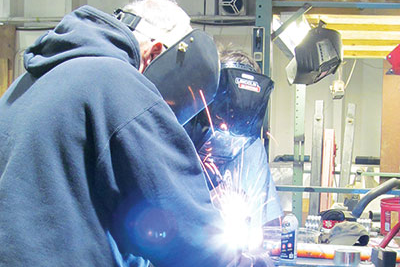
Flight Expo provides a hands-on introduction to the aviation field. Teenagers tear down engines, fabricate parts and build airplanes under the supervision of the Sandbergs, a family that’s spent a lifetime in aviation.
“We really wanted to get kids involved in the hands-on aspect, get into the nuts and bolts,” said Sharon Sandberg, who founded and directs the program with her husband, Duane Kruse, and their nephew, John Bjornstad. “If we don’t get the kids early, they are already hooked on another activity. Our society is losing these skills because we don’t have them in our schools or in activities outside of school.”
There’s a pressing need for the technical and mechanical skills that Flight Expo introduces to the next generation. The aviation business is facing a critical shortage of mechanics and technicians as the Baby Boomers enter their retirement years. In fact, a record number of aircraft maintenance technicians will be eligible to retire over the next decade. In the United States, the median age of aviation mechanics is 51 years old, according to the U.S. Bureau of Labor Statistics. That’s nine years older than the median age of the overall U.S. workforce.
Generating Revenue
Unfortunately, funding for nonprofits like Flight Expo can be difficult to obtain. That’s why the Initiative Foundation’s Financial Resiliency through Social Enterprise (FRSE) program aims to give nonprofits the tools and training to generate income for their valuable work.
Since FSRE began, dozens of Central Minnesota nonprofits have graduated from the yearlong program, which offers a crash course in business planning, market research, finance and law, said Chris Fastner, senior program manager for organizational development at the Initiative Foundation.
“We are in our sixth cohort of training and have graduated 35 nonprofits,” Fastner said. “Now we actually are running FRSE 2.0—a next-step program that provides higher-level training to past graduates. We currently have 10 organizations participating at that level.”
In the program, local nonprofits receive training from experts in finance, marketing, law and other disciplines essential to running a successful business. And that’s the point: Running a successful nonprofit requires many of the same skills as running a successful business. The Initiative Foundation’s FRSE program actually takes that a step further by teaching nonprofits how to create a business that will generate revenue to support their mission-driven work.
Labor of Love
Sandberg and Kruse already run a screen-printing and embroidery business that targets the aviation industry. They make shirts, hats, bags and a variety of commemorative items for military and civilian aviation enthusiasts.
Now they’re exploring the possibility of combining their business with Flight Expo, so the business can help support Flight Expo’s work to engage the next generation and expose them to potential careers in aviation. “The Initiative Foundation has been very helpful with advice, plugging me into other organizations for legal and operational knowledge,” Sandberg said. “They have really gone out of their way to help us and point us in the right direction.”
It’s a labor of love for the family. Sharon’s dad, John R. Sandberg, was a legend in Minnesota aviation. After service as an Air Force mechanic, he started a precision machine shop to serve the aviation community, later building and racing high-powered planes.
He custom-built a P-51 Mustang fighter that he named Tsunami with the goal of setting a world speed record for piston-engine planes. On a routine flight in 1991, John R. Sandberg was killed when Tsunami crashed.
Sharon thinks of her dad whenever she sees the joy of a kid’s first exposure to flying.
“Seeing the smiles on their faces, knowing that when I’m gone someone else is carrying the torch—that passion for aviation—that’s a great satisfaction,” she said.
So far, 28 students have graduated from Flight Expo. One is currently in college studying to become an airframe and powerplant (A&P) mechanic; another is training as a welder. Even those students who may not go on to aviation careers are thrilled by the experience of working with real planes—especially since the course ends with a flight in a small plane and maybe even a chance to take the controls.
“I’ve definitely become more interested in flying” since taking part in Flight Expo, said 15-year-old Owen Nitz of Zimmerman, who finished his first session in spring 2017. A career in aviation “is definitely something I would consider.” Owen’s summer plans include taking apart his dad’s vintage Ford Torino.
Chase Robideau, a 15-year old from Princeton, learned riveting and metal fabrication. He also made and installed wing brackets for Tsunami, which Bjornstad is rebuilding. Chase said he enjoyed “pretty much everything” about the course and hopes one day to work at Cirrus Aircraft, the small-plane manufacturer based in Duluth. That’s exactly the outcome the Initiative Foundation hopes for, Fastner said.
“There are thousands of nonprofits in Central Minnesota, and while we value the work of all of them, we especially want to invest in those that support job skills training and workforce development,” Fastner said. “We want to help raise up people. We want to help them gain the skills needed for better jobs.”
And maybe help out a teen who has her eyes on the sky.