A Winning Formula
Rethinking the need for everyone to have a 4-year college degree.
By Gene Rebeck | Photography by John Linn
Though the details may differ, Tom Haglin echoes the frustration of many Central Minnesota employers. “If we had 12 or 15 applicants who had not only the soft skills, but also knowledge or some exposure to the technical side, we could use all 12 or 15,” he said. The problem is, those skills aren’t easy to find.
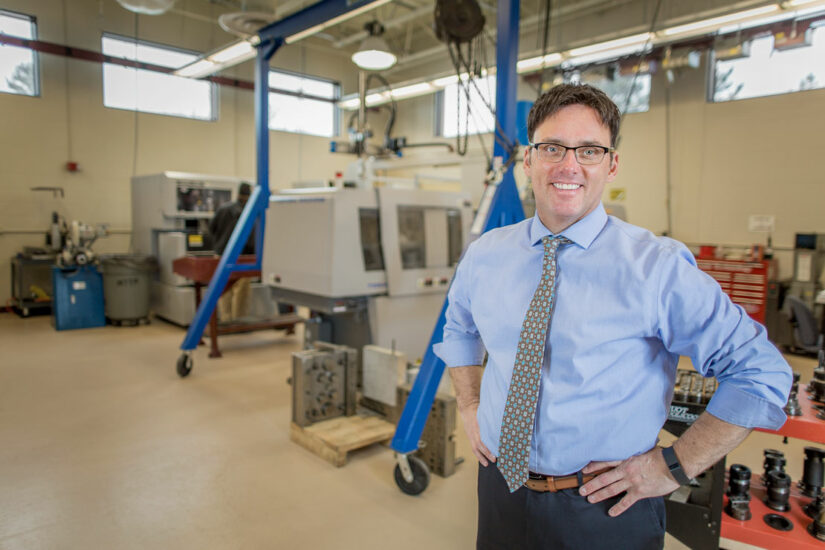
Haglin co-owns two Baxter-based manufacturing companies. One is LINDAR Corp., a precision manufacturer of paint tray liners, food containers and other plastic products. The other, Avantech, makes tooling for rotational molding, a technique for fabricating plastic parts. Together, the businesses employ 210 people. Just about all of Haglin’s equipment is computerized, and he said it’s difficult to find technically experienced machine operators.
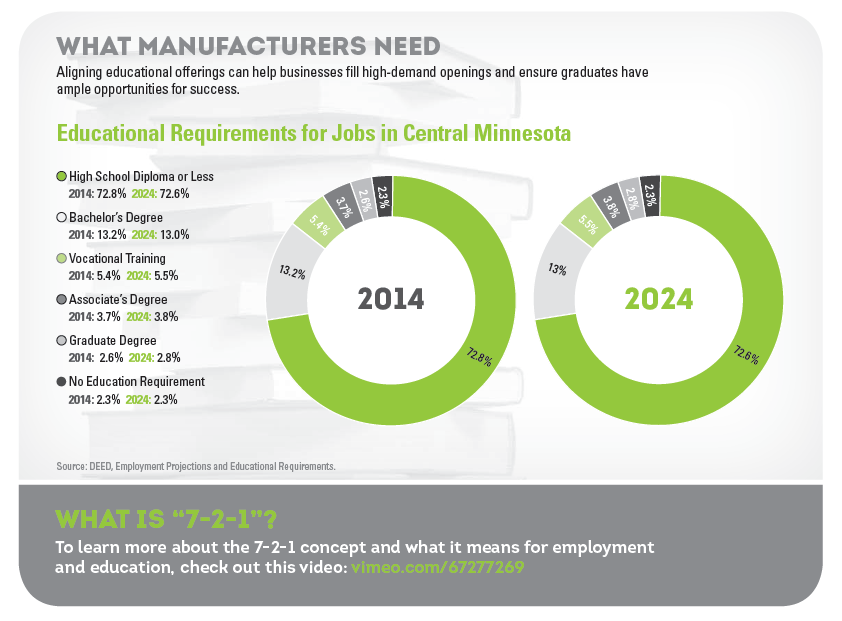
Manufacturers, healthcare providers and other businesses throughout Central Minnesota are clamoring for skilled talent. But here’s something worth noting: A great many of those positions don’t require a four-year college degree. Most require some postsecondary education, but in those cases, a certificate or a two-year associate’s degree is usually sufficient.
Studies by the Bureau of Labor Statistics, the Conference Board and Pathways to Prosperity, a project of the Harvard Graduate School of Education, show that for every 10 jobs, the U.S. economy needs seven new workers with technical college training, two with four-year degrees and just one grad with an advanced degree. It’s called the 7-2-1 formula, and it goes against the widely embraced notion that nearly everyone needs a four-year degree to succeed. The studies suggest that the 7-2-1 formula also applies to workforce needs in Central Minnesota.
In Demand
Hara Charlier, president of Central Lakes College in Brainerd, defines talent as “the right people with the right skills to fill a job opening.”
Thanks to close connections with regional employers, the state’s community colleges know the type of talent that’s in demand. Welders and people who can handle advanced machining “are really tight right now,” said Joe Mulford, president of Pine Technical and Community College in Pine City. Health care—including RNs, LPNs and medical assistants— has been “consistently tight.”
The worker shortage isn’t restricted to Central Minnesota. “Over the next 15 years, the state of Minnesota will have to hire for 1.3 million jobs,” Charlier noted. “Some of that is related to growth, some is related to turnover.” Because of the types of jobs that are expected to be created in the next decade and a half, “we know that three out of four of those jobs will require some college,” she said. But in many cases, those positions require certificates, one-year diplomas or associate degrees—not a four-year diploma.
All this suggests that a two-year degree “has never been more versatile,” Mulford said. And community colleges are designing their certification and associate degree programs to be more flexible as employer needs and technology evolve and employee ambitions change.
“Many of the courses at a two-year institution are aligned to a bachelor’s degree—in order for students to move into management, for instance,” Mulford said. At Central Lakes College and St. Cloud Technical & Community College, many of the certificates and two-year degrees are “stackable”—meaning that their credits can carry over into higher degrees, if needed.
The Next Generation
Mulford has been sharing the 7-2-1 concept and what it signifies to high school students, among others. His message: “You don’t have to go to a university to be successful.”
Charlier noted that many employers in the region also are spreading the word to bridge what she called “the interest gap” in technical fields. Area employers meet students to talk about their businesses and the types of skills they need—and the career opportunities they offer. In Brainerd, the Initiative Foundation-supported Bridges Career Academies and the Bridges Workplace Connection help expose high school and postsecondary students to businesses and careers, including manufacturing.
Throughout the region, the Initiative Foundation and its hosted Partner Funds are awarding grants to provide funding for robotics clubs and other STEM-related classroom and extracurricular activities that school district budgets alone cannot afford to support.
Such efforts will be needed to attract students to manufacturing and other sectors in the region with good prospects and pay—opportunities that can allow them to stay close to home. As Mulford noted, “There are opportunities for regional business growth that are being limited by our ability to get a workforce ready.”