Master Work
Central Minnesota veterans support a permanent memorial to the men and women who served their country.
By Laura Billings Coleman | Photography by John Linn
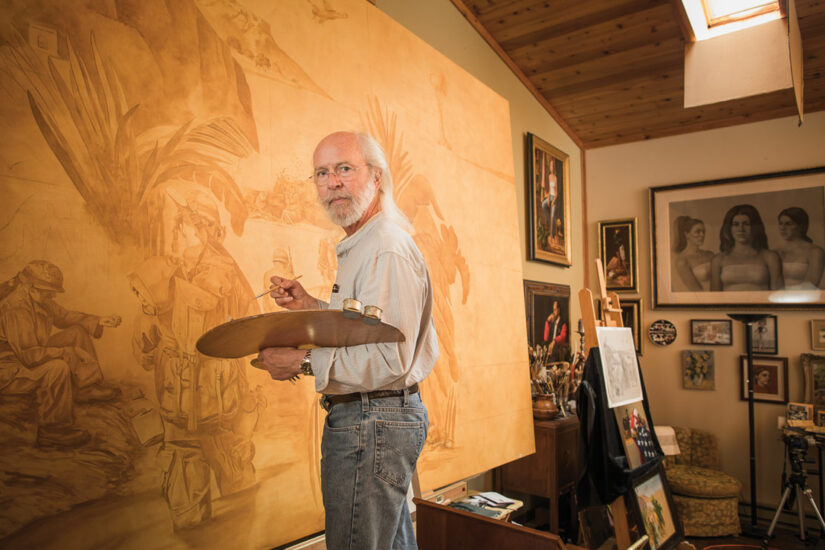
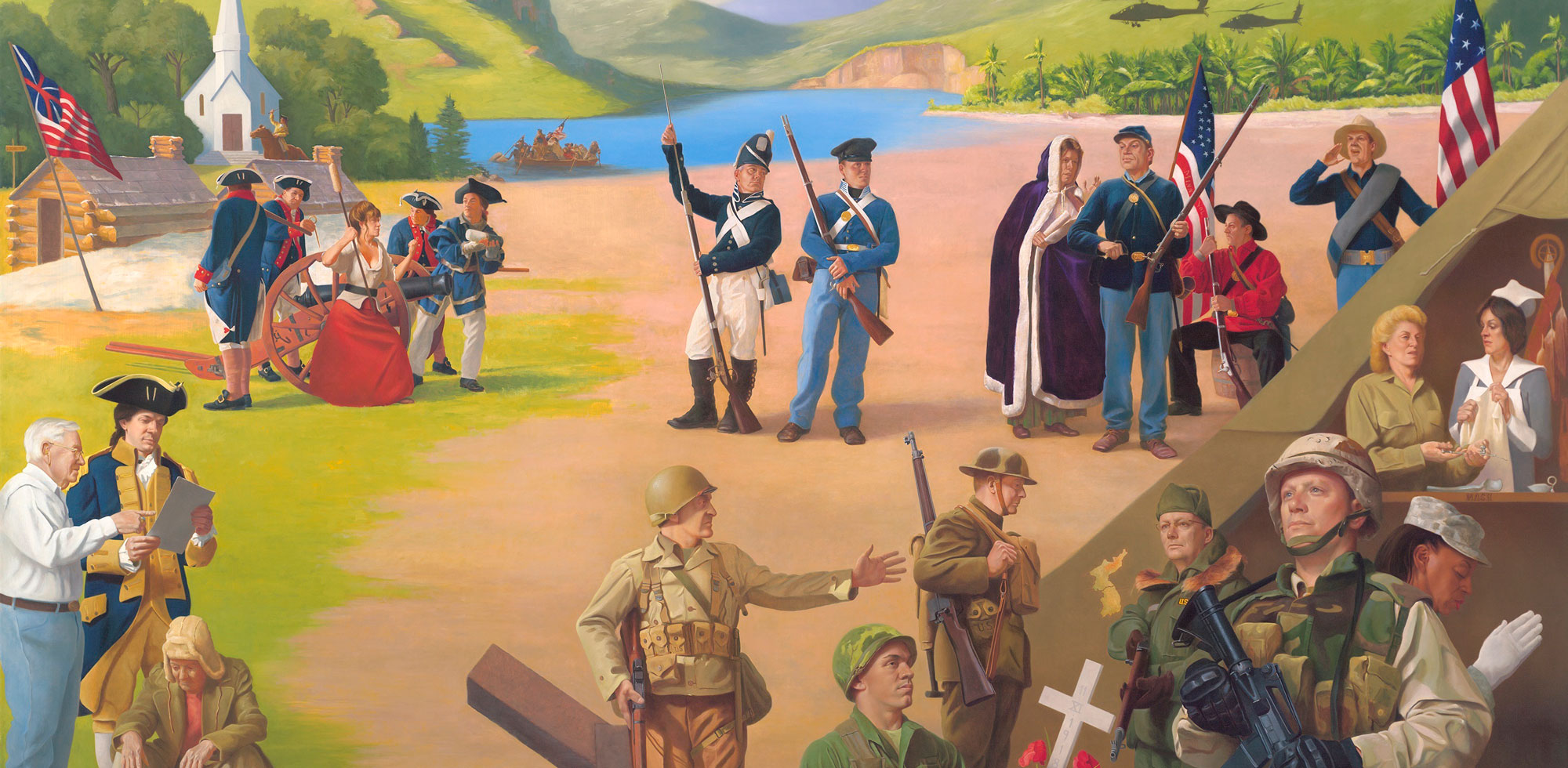
Reflecting on the sacrifices more than 361,000 Minnesota veterans have made for their country is a ritual many of us will mark on Veterans Day. But for Little Falls artist Charles Kapsner, looking closely at America’s servicemen and women has been a full-time occupation since 2009, when he accepted an unusual commission to create commemorative paintings for each of the armed forces at the Minnesota State Veterans Cemetery in Little Falls.
The son of a veteran and a student of history, Kapsner was quick to enlist for a once-in-a-lifetime assignment that’s allowed him into military archives at West Point and Annapolis, and into the confidence of local vets who’ve posed for him in his studio. With paintings that cover the history of the Army, Navy and Coast Guard now complete, he’s closing in on finishing the fourth installment of his magnum opus, applying the final brushstrokes to the Battle of Belleau Wood and other turning points in the history of the U.S Marine Corps. The painting is expected to be placed in the cemetery’s Committal Hall in early 2018.
I keep saying this is my own Sistine Chapel project,” said Kapsner, who applies the classical technique he learned as a student in Florence, Italy’s Università Internazionale Dell’Arte to each 8- by 10-foot canvas. “I just can’t paint any faster.”
While Kapsner has been the focus of considerable arts coverage over the last nine years, the behind-the-scenes effort to fund this $485,000 public art initiative may be its own master work, one that’s mobilized a volunteer force of more than 30 veterans of World War II, Korea, Vietnam and other conflicts, as well as donations from individual donors from across the region. Those donations include memorials and individual donations of $1 (which added up to thousands) to major support from veterans organizations, local and regional businesses ranging from $1,000 to $25,000. “This project’s impact is far-reaching,” said Kristi Ackley, community philanthropy specialist at the Initiative Foundation and a 12-year Navy veteran. “Initially envisioned by veterans, the monument unites art, history and community. And it speaks volumes about the donors who believe in the honor, commitment and sacrifice of the men and women of every branch of the U.S. military.”
Now with $130,000 left to raise from the community, the Veterans Art Monument is already teaching the next generation about the character and culture of each branch of service—and what it takes to get big ideas done in small communities.
For Navy vet and clinical nurse Phil Ringstrom, who spent part of his career developing counseling programs for returning vets in several regional Veterans Administration health systems, bringing the Veterans Art Monument paintings to light has shown him a different side of the service experience. “Working for vets’ health I’ve often dealt with the harsh realities and the real challenges veterans face, but talking to people about this project has been a joy,” he said. “I’ve seen how much Minnesotans care about their vets, and they’ve been so generous. It’s a lot of money we have left to raise, but I don’t see anything standing in our way.”
Character and Culture
The Veterans Art Monument was the brainchild of former state representative Gordon Gerling, who died last year at the age of 94. A one-time U.S. Army radio operator/gunner who served on a B-24 with the 404th 11th Air Force Bomber squad, Gerling first approached Kapsner about creating an allegorical fresco about the armed forces, the same medium Kapsner used to create a series of celebrated historic tableaux at Lindbergh Elementary School in Little Falls. But once the artist and a delegation of local vets took a closer look at the Minnesota State Veterans Cemetery Committal Hall, they saw that the five walls of the room would provide the perfect setting for large-scale oil paintings, one for each of the armed services.
“Of course, almost as soon as we launched fundraising in 2008, that’s when the economy went in the tank,” said Jack Peck, president of the Minnesota State Veterans Cemetery Memorial Association and a former Navy airman. Recognizing that the effort could be a years-long campaign was one important factor behind the group’s decision to start a Special Project Fund at the Initiative Foundation, a fundraising vehicle that allows community donors to make tax-deductible contributions toward the project, while gaining valuable technical support from Foundation staff. For instance, the Initiative Foundation paid for a fundraising brochure for the team to distribute through the community, and has provided ongoing strategic assistance on everything from attracting media coverage to securing private support from major funders like Minnesota Power, which made a $10,000 gift to the effort just before Memorial Day.
“In almost any fundraising effort, supporters think, ‘If everyone in the community gave ten dollars we’d be finished,’ but that’s just not how community philanthropy works,” said Ackley. “There are so many great ideas competing for people’s time and resources that you really have to think about how your project can rise above some of the others, and get people’s attention.”
Navy vet and memorial volunteer Bill Osberg has taken that advice to heart on his trips to talk with potential donors, or visit with VFW members curious about the project. “One thing I think is important is that Committal Hall is the last place that these families spend time with the casket or the urn, it’s the last moment they’ll have, and when you’re grieving, those paintings have an impact,” he said. “You can’t help but notice them, and they mean a whole lot to those families.”