
Small Towns, Big Change
Grassroots teams in Hackensack and Milaca show how small towns can turn ideas into lasting change
By Jon Spayde | Photography by John Linn and Paul Middlestaedt
A decade ago, Hackensack, with a population of about 300, was in the civic doldrums.
Located in Central Minnesota’s lake country, the town lacked the public amenities that could attract tourists and lake-home owners. There were no child care facilities, no community center, no dog park. The surface of its municipal tennis court had buckled so severely it was unplayable. The town looked and felt run-down, tired, even defeated.
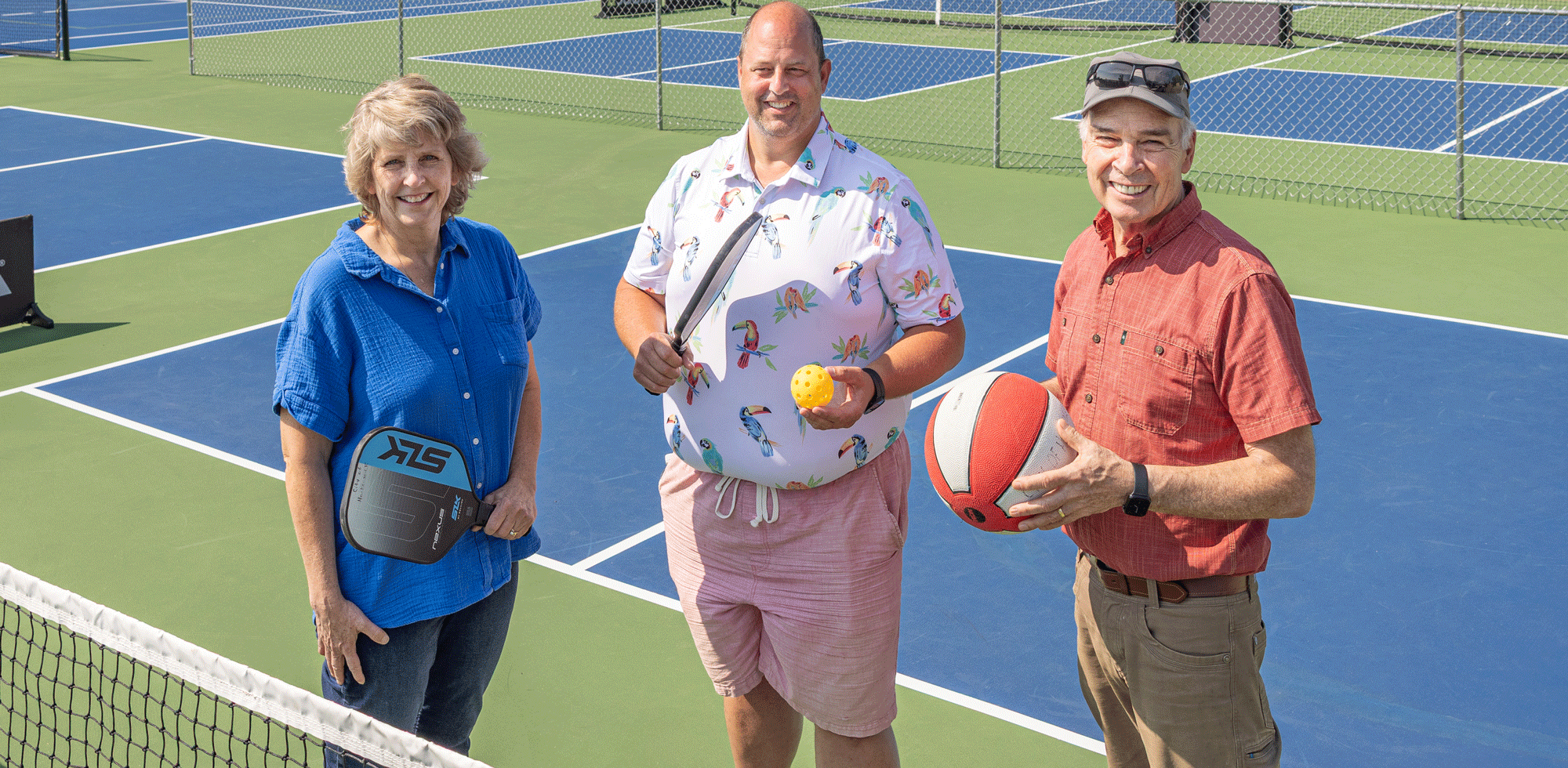
Today, Hackensack has come alive. A colorful sign welcomes visitors approaching from the south on Highway 371. Hang a left on Murray Avenue toward Birch Lake and you’ll see the revamped tennis courts, an expanded basketball court and a new pickleball court surrounded by an even newer wind-blocking screen.
Go east to the end of Lake Avenue and you’ll find the dog park, an 18-hole disc golf course and the town’s community garden. Towering over it all is a spruced-up water tower bearing a town logo that mirrors the welcome signage. All of this and more—thanks to the work of a grassroots nonprofit called the Game Changers.
About 100 miles southeast, Milaca—a town of 3,000—has been charting its own path forward. In 2011, with help from the Initiative Foundation, residents launched the Rum River Community Foundation to fill the gap left by the absence of traditional service clubs like the Lions or American Legion. Since then, the Rum River Community Foundation has fueled a steady stream of community projects.
It’s no surprise, then, that the Initiative Foundation’s reboot of its Thriving Communities program is drawing inspiration from the work in Hackensack and Milaca as it helps small towns chart the next wave of community projects.
New Action, New Traction
Amy Trombley, the Initiative Foundation’s vice president for community, believes the stories of Hackensack and Milaca will spark ideas in other Central Minnesota towns. “What’s powerful about these communities,” she said, “is that the projects they’ve built aren’t just quick wins—they’ve delivered real results and stood the test of time.”
The Thriving Communities program relaunched in July as the second act of a once-popular program that first debuted in the late 1990s. It was phased out a decade ago when funding ran dry, but its mission remains the same: empower residents to pinpoint their community’s toughest challenges and draw on their knowledge and creativity to solve them. The first round of this new chapter for hometowns with populations of 5,000 or less includes the communities of Braham, Motley, Sebeka, Staples and Taylors Falls.
The program provides training, coaching and program referrals to homegrown teams who will spearhead the work in each town. Each community will receive an initial $2,500 grant to support the planning process and another $2,500 for implementation. Each will then be eligible for additional grant funding of up to $10,000.
The goal is simple: inspire and equip local leaders to spark action from within their communities. “Residents will work side-by-side to shape the future—and make the changes last,” Trombley said.
The Magic of a Band Shell
When Milaca’s leaders joined the first iteration of Thriving Communities, they knew they needed a project that would prove the effort was more than just talk. The town’s aging band shell—scallop-shaped, crumbling, and poorly lit—was an easy choice.
“It was in bad shape,” recalled Mayor Dave Dillan. “I mean, really bad shape. It was falling apart.”
Backed by a $2,500 seed grant, the team launched its bandshell repairs. The transformation was dramatic: Today, the pristine band shell is the site of concerts and community gatherings. More than a facelift, Dillan said, it built trust. “Revamping it made something that people could look at and say, ‘If I give my $500, I see where it’s going. It’s not going to some mystery fund.’ That really helped us build credibility.”
That early win didn’t just save a highly visible local landmark—it sparked new community-shaping ideas.
In its decade and a half of existence, the Rum River Community Foundation has gone on to support a constellation of community needs and amenities, including a parade, new equipment for the fire department, fireworks displays, a club supporting diabetic youngsters and a program that secretly slips free food into the lockers of students experiencing food insecurity at home.
The foundation keeps itself in the public mind by sponsoring two annual events: a spring gathering during which grants are announced, and OktoberFiesta, a German-Mexican mashup of tacos and tankards aimed at attracting a younger crowd.
Hackensack’s Civic Spark
Hackensack’s Game Changers got started when a group of locals, including soon-to-be mayor Bill Kennedy and businessman-turned-life-coach Gary Dietrich, came together to see if they could change the town’s game. Informal conversations and pandemic-era Zoom calls turned into a gathering in a local restaurant where town folks—and people with homes on the 127 lakes within a 10-mile radius of town—shared their visions of a revitalized community.
“There were, I think, five or six ideas that were floated around,” Dietrich said. “And all of those ideas later on became Game Changer teams.” Two other milestones advanced the civic-change agenda: the election of Kennedy to the City Council in 2019, and, in the same year, the creation of the Hackensack Lakes Area Community Foundation, a Partner Fund of the Initiative Foundation. Kennedy would later go on to become mayor in 2021.
The Game Changers formed their own 501(c)(3) nonprofit in 2020 and routinely receive grants from the Hackensack Lakes Area Community Foundation. Today, 15 teams are working on various projects.
The Game Changers’ scheme is straightforward: anyone can form a team and submit a simple application to the Game Changer board. If approved, the application goes to the City Council for a final thumbs-up. The team is responsible for fundraising as well as execution. “It’s not like you pitch the idea over the fence and run away,” Kennedy said. “Your team has to be the vehicle to help make that thing happen.”
Plenty happened. The Game Changers raised $8,000 to add Hackensack’s colorful logo to the town’s water tower. The dog park was created on land donated to the city. “That one took a long time to fundraise for, because not everybody’s into a dog park,” said Game Changers treasurer Kris Biessener. Still, the project moved forward and proved successful. “It’s quite busy, with a lot of tourists bringing their dogs.”
Another big draw has been the Hackensack sports courts. When a citizen gave the city $5,000 to repair the decayed tennis court, a couple of Game Changers swung into action to go beyond those repairs. Dan Kellogg, a member of the local pickleball club, teamed up with Sue Toth, co-owner of Rendezvous, the town’s brewpub, to fundraise for an outdoor pickleball court and an expansion of the basketball court, too.
“We were able to raise money faster than anyone thought we could,” Toth said. The project proved popular, with people traveling from towns near and far to play.
Toth was also the sparkplug for that welcome sign south of town, and she’s currently negotiating with MnDOT to create wayfinding signs within city limits and another welcome sign north of Hackensack on Highway 371, which is being resurfaced through town.
To keep neighbors informed and engaged, the Game Changers publish quarterly editions of Lucette’s Gazette—a newsletter for the Hackensack Lakes Area. Its pages are filled with local news, event spotlights and updates on community projects, helping residents stay connected and invested in their town’s success.
The newsletter riffs on the local statue of Lucette—Paul Bunyan’s sweetheart—which gives Hackensack its own playful twist on Minnesota folklore.
Biessener and her Lane Changers team are bringing a multimedia approach while the road repairs are underway. Each week, they send an email to 500 subscribers. The email includes drone footage of road construction and tips on the best routes people can take to avoid delays when visiting Hackensack.
The Game Changers are several years into tackling two of Hackensack’s larger challenges: affordable housing and childcare.
Mann Lake Beekeeping and Ag Supply, a national business with 200 local employees, is the town’s largest employer—but workers there, like many others, often face long commutes because starter homes and rental properties are scarce.
Dietrich led the Game Changer effort to create a childcare center for these families. The Great Start center now operates in the basement of Union Congregational Church, and Dietrich is working with Biessener and the Resilient Housing team on Woodland Corners, a multi-family housing project. The land has been purchased, and the team is collaborating with St. Cloud nonprofit developer Central Minnesota Housing Partnership.
Some residents worry that multi-unit housing could bring socioeconomic decline, but Dietrich remains optimistic. “I can’t think of a single Game Changer project that hasn’t been a success,” he said, confident that the town’s track record will carry the project forward.
Added Biessener: “We’re just a perfect storm for positivity and change.”
The Foundation’s Thriving Communities program (previously known as the Healthy Communities Partnership) has worked with 80 cities, six counties and, in the greater St. Cloud area, eight core neighborhoods since the late 1990s to plan for healthy, vibrant futures. A snapshot of past participants and their accomplishments:
LITTLE FALLS: The community team helped to develop the Shoppes of Little Falls—a retail incubator where as many as two dozen local vendors display their products under one roof. The team also addressed park improvements and economic development work to make industrial sites shovel-ready.
FOLEY: A desire to better connect the community led to the creation of two family-friendly annual community events. The Foley team also completed a downtown revitalization plan in conjunction with Center for Rural Design and kick-started a local farmers market.
LONGVILLE: The Longville area rallied around park development, economic development and aquatic invasive species control. They produced a community guide for visitors and residents; relocated and improved a community skating rink; and created and distributed invasive species materials to resorts and area businesses.
BRAHAM: Thanks to the work of the Braham Area Committee For Kids (B.A.C.K.), the town raised funds to improve its football, baseball and softball fields. And the crown jewel of their efforts was the Braham Event Center, which offers programs for seniors and the area’s youth and features banquet space for weddings and other events.
LONG PRAIRIE: One of the program’s earliest participants, members of the Long Prairie community focused on downtown revitalization, community theater and local park expansion. The improvements included the creation of Veterans Memorial Park and a Long Prairie tourism board. The team also championed a renovation of the historic Reichert Hotel, a once-abandoned building in the heart of downtown, to create affordable multi-family housing.